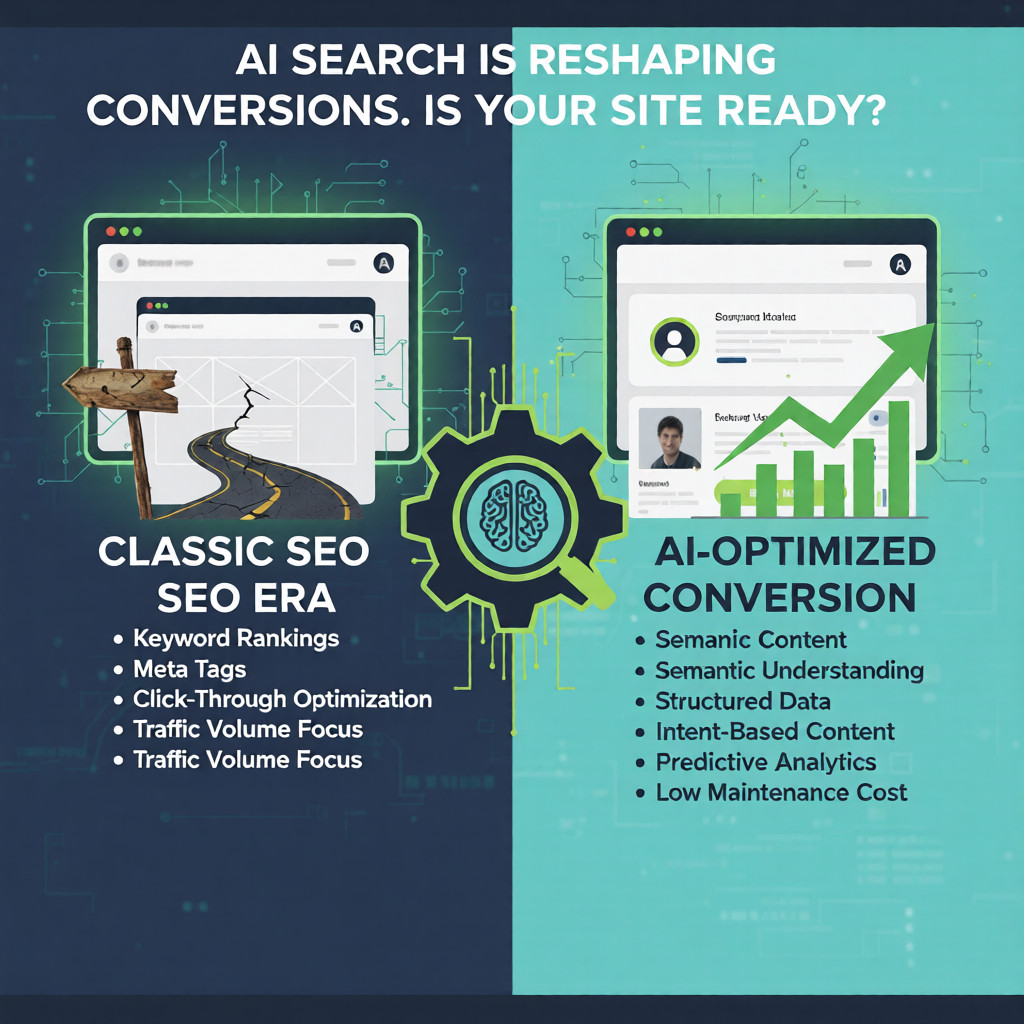
How AI Search Is Changing Website Conversions

In today’s digital landscape, AI-powered search isn’t just another trend — it’s rewriting how users discover, evaluate, and convert on websites. If your site was built for classic SEO and click-through optimisation alone, it’s already falling behind.
In 2025, AI search is reshaping conversions — and most sites are nowhere near ready.
🧠 What AI Search Really Means Today
Modern search isn’t limited to traditional link lists anymore. Tools like Google’s AI Overviews, Bing AI, ChatGPT, and other generative models deliver conversational answers, comparisons, and even direct solutions before a user ever clicks through to a website.
This has created a new reality: many queries now end in zero-click results — where users get their answer on the search page itself. Wikipedia
For marketers and businesses, this shift is seismic.
📉 Why Traffic Isn’t the Only Metric That Matters
🔹 Fewer Clicks, But Higher Conversion Intent
It’s true: overall traditional organic traffic — based on links — is declining as AI summaries satisfy users immediately. Studies show that when AI summaries appear, search result click-through rates drop significantly. Wikipedia
Yet paradoxically, the users who do click through are deeper in the conversion journey.
According to industry data:
- AI-driven search referrals often convert at higher rates than traditional search visits. Bing Blogs
- AI visitors tend to be more informed and closer to decision-making — meaning they arrive ready to take action. Search Rewired by MK
In short: traffic volume may fall, but conversion quality improves.
🚨 Most Websites Are Still Built for the Old World
Despite these trends, the majority of websites remain designed for classic SEO:
✅ Keyword rankings
✅ Meta tags
✅ Click-through optimisation
…but they ignore how AI evaluates and surfaces content.
Here’s why that’s a problem:
❌ 1. Traditional SEO Doesn’t Influence AI Summaries
Search engines and AI tools now interpret content differently. They generate results based on:
- Semantic understanding of content
- Structured answers
- Data quality and authority
Traditional ranking signals alone aren’t enough. Wikipedia
❌ 2. Zero-Click Searches Reduce Site Engagement
AI summaries increasingly answer queries without any site visits at all — meaning your content could be read by users without a click. Wikipedia
Without adaptation, this leads to:
- Lower engagement
- Fewer leads/sales
- Inflated impression metrics with no real conversions
❌ 3. Conversion Paths Are Not AI-Optimised
Most conversion funnels assume:
- Find site via search
- Click through
- Engage with landing page
- Convert
AI breaks this model. Now users may interact with your content within the search interface itself — or after multiple AI-led queries — before ever seeing your site.
🛠 What AI-Optimised Conversion Looks Like
To win in the AI-powered era, you must rethink how your site works. Here’s how:
🔹 1. Build for Intent, Not Just Traffic
AI search tools prioritize user intent — what the user is trying to accomplish. This means your content should:
- Answer specific questions clearly
- Be structured for concise extraction
- Match searchers’ goals at every stage
This is the foundation of Generative Engine Optimization (GEO) — optimization for AI systems, not just search engines. Wikipedia
🔹 2. Use Structured Data and Clear Signals
Structured data (schema) helps AI understand your content’s purpose. It tells machines what your content is — not just that it exists.
Focus on:
- FAQ schema
- Product and service schema
- How-to schema
This makes your content more likely to be included in AI responses.
🔹 3. Design for AI + Human Users
Your site needs to serve both:
- AI systems (for extraction and summarization)
- Human visitors (for conversion)
Ensure:
- Clear, irresistible CTAs
- Simplified flows
- Intent mapping by page
This alignment boosts conversions from both traditional and AI-driven visits.
📊 Conversion Opportunities AI Search Creates
AI search isn’t just a threat — it creates new opportunities:
🎯 Better Lead Quality
AI users often click only when they are decisive — meaning a smaller audience can yield a higher conversion rate. Bing Blogs
🎯 Pre-Qualified Traffic
Users who navigate through AI search are more informed — and thus more likely to convert when they land on your site.
🧩 The Future: AI Search + Conversion Strategy
To stay competitive:
📌 Track AI visibility (not just SEO rankings)
📌 Optimize content for AI extraction and citation
📌 Monitor interaction metrics, not just clicks
📌 Focus on structured, intent-aligned experiences
🚀 Final Takeaway: Convert Clarity Into Conversions
AI search is changing how users find — and interact with — content.
If your website is still focused on old SEO tactics, you will:
❌ Lose visibility in AI responses
❌ See traffic that doesn’t convert
❌ Fall behind competitors who adapt faster
But if you embrace AI-oriented search and conversion strategy:
✅ You’ll turn high-intent AI users into customers
✅ Your site will become part of the new search economy
✅ Conversion rates will rise even if traffic dropsAI search is not just a shift in technology — it’s a shift in user behavior.
And the websites that understand this will win the next decade.