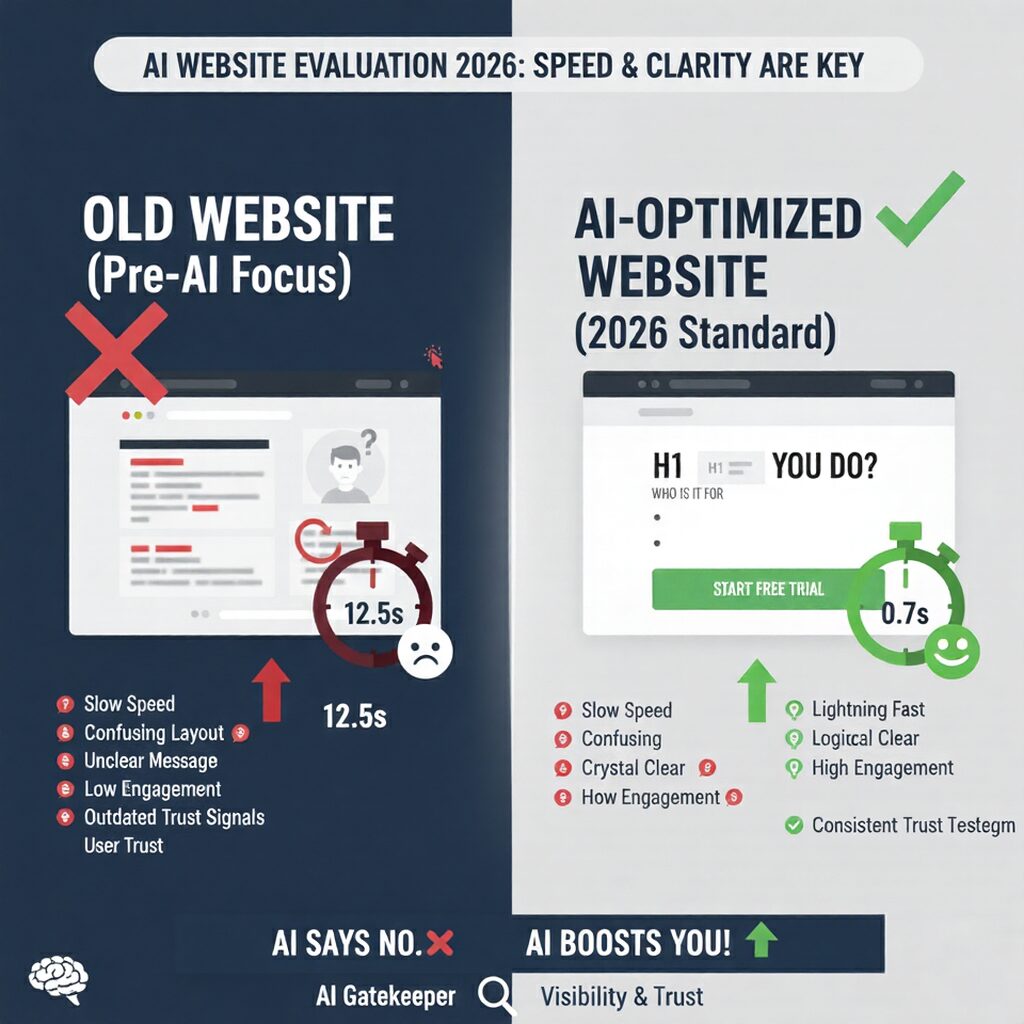
How AI Evaluates Websites in 2026 (And Why It Matters)

In 2026, websites are no longer evaluated only by human visitors or traditional search engines.
AI-driven systems now play a major role in deciding which websites get visibility, trust, and recommendations.
This includes AI search engines, voice assistants, chatbots, and recommendation systems.
This shift is subtle — but its impact is significant.
AI doesn’t simply scan keywords or backlinks.
It evaluates how your website performs, how clearly it communicates, and how users interact with it.
A website that looks “good enough” to humans can still fail AI-driven evaluation.
What AI Looks at When Evaluating a Website
1. Website Speed and Performance
Website speed is one of the strongest quality signals.
Slow-loading pages indicate friction, poor experience, and low reliability.
AI systems associate fast-loading websites with professionalism, trust, and authority.
2. Clarity of Messaging
If your website cannot clearly explain:
- What you do
- Who you serve
- Why it matters
within a few seconds, AI struggles to understand it too.
Clear positioning helps both users and AI systems interpret your website correctly.
3. Structure and Readability
AI favors websites with:
- Logical heading hierarchy (H1, H2, H3)
- Clean layouts
- Short, scannable paragraphs
- Clear content sections
Structured information is easier for AI models to process and summarize.
4. User Engagement Signals
AI evaluates how users behave on your website, including:
- Bounce rate
- Time on page
- Navigation patterns
- Interaction depth
High exits and low engagement signal a poor experience — even if the content itself is strong.
5. Trust and Consistency
Outdated designs, broken elements, or inconsistent messaging reduce credibility.
AI systems prioritize websites that appear:
- Stable
- Reliable
- Actively maintained
- Consistent in branding and messaging
Why This Matters for Businesses in 2026
Many businesses still optimize websites only for human visitors.
That approach is no longer enough.
AI now acts as a gatekeeper.
If your website is slow, confusing, or unclear, AI-driven platforms are less likely to surface it — regardless of how good your product or service is.
This is why:
- Simple websites outperform complex ones
- Faster sites rank better than visually heavy sites
- Clear messaging beats clever design
What Actually Works in 2026 (According to AI Systems)
Websites that consistently perform well share common traits:
- Fast loading times
- Clear and focused messaging
- Simple, logical structure
- Strong user experience
- Consistent trust signals
AI does not reward:
- Visual noise
- Overcomplicated layouts
- Clever but unclear messaging
AI rewards clarity, performance, and reliability.
Final Thoughts
Your website is being evaluated before a human visitor ever decides to trust you.
AI systems are already forming opinions about your site based on:
- Speed
- Structure
- User experience
- Trust signals
If your website hasn’t been reviewed through this lens, it may already be falling behind — even if it looks fine on the surface.Optimizing for AI is no longer optional.
It’s a core part of modern website strategy.