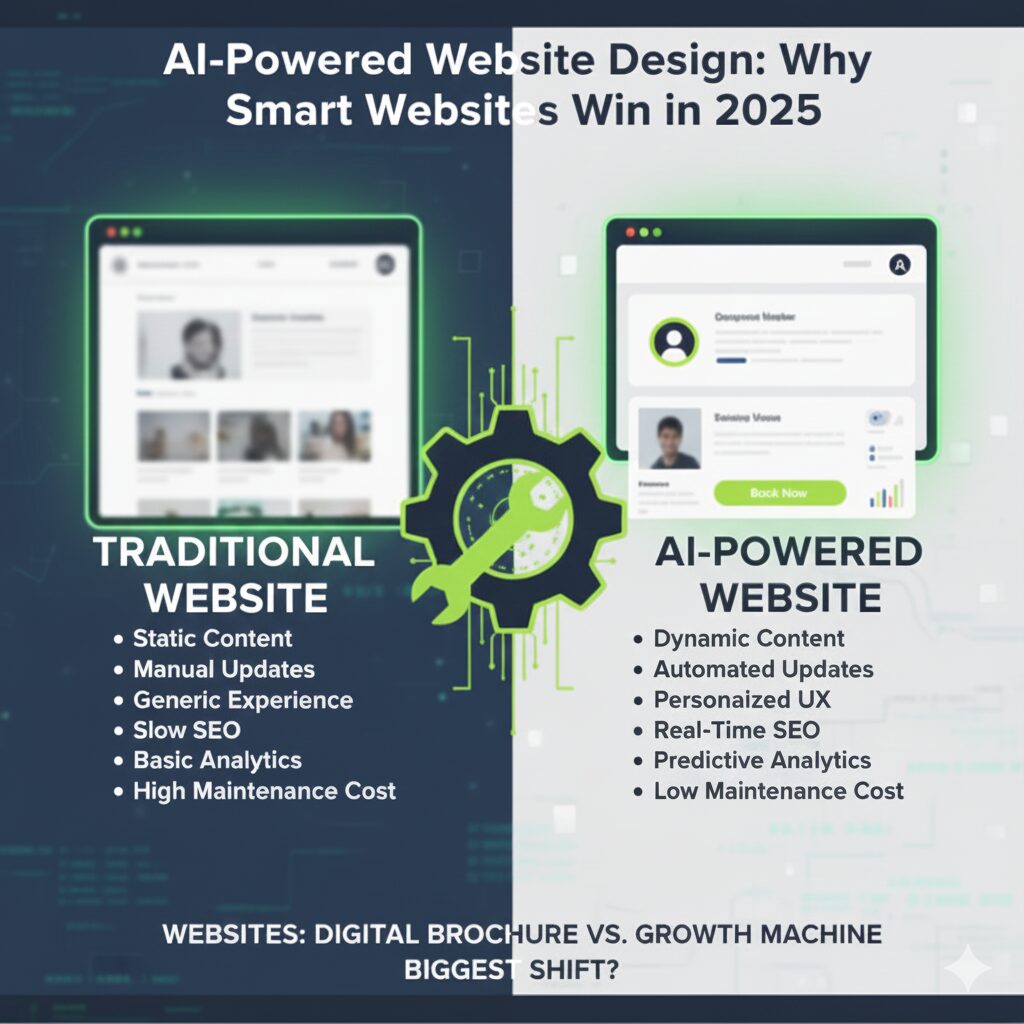
AI-Powered Website Design: Why Smart Websites Win in 2025

Introduction: The Rise of Smart, AI-Powered Websites in 2025
The way businesses design and use websites has changed more in the last two years than in the previous decade. In 2025, websites are no longer just digital brochures. They are becoming smart websites 2025, adaptive, AI-powered growth machines that understand user behavior, automate interactions, generate personalized experiences, analyze data, and help businesses convert more clients without increasing workload.
With the rise of AI-driven search tools like ChatGPT Search, Perplexity, and Google SGE, online competition is tougher than ever. Businesses need websites that are not only visually impressive but fast, intelligent, and optimized for AI discovery. This is exactly where AI-powered website design wins.
A smart website today can generate leads automatically, support customers 24/7, personalize content, predict user needs, optimize SEO, and adapt in real-time — something traditional static websites can never do.
In this blog, you’ll learn exactly why AI-powered websites are the future, how they help businesses grow faster, and why 2025 is the year smart websites become a must-have — not a luxury.
As we look ahead, the emergence of smart websites 2025 is set to redefine how we approach online engagement and customer service.
1. What Is AI-Powered Website Design?
AI-powered website design means using artificial intelligence, machine learning, automation, and data-driven decision-making to design, manage, and optimize websites.
A smart website leverages AI tools such as:
- Predictive analytics
- Personalization engines
- Automated chatbots
- AI-generated content
- Real-time SEO optimization
- Automated funnels
- Behavior tracking
- AI-based user testing
Instead of being static, your website becomes dynamic, adjusting automatically based on what each visitor needs.
For example:
- If a user is looking for pricing → the website shows pricing first
- If a visitor is returning → it recommends content they haven’t seen
- If someone hesitates on checkout → a chatbot gives them a discount
This is the shift from “websites that display information” to websites that think, decide, and convert.
2. Why Smart Websites Are Dominating in 2025
2.1 The World Now Operates on AI-Driven Search
People are no longer only searching on Google.
- ChatGPT Search
- Perplexity AI
- Bing AI
- Google AI Overviews (SGE)
These tools gather answers from multiple websites and give users direct results.
This means:
➡️ Only highly structured, SEO-optimized, AI-friendly websites will get traffic.
➡️ Simple websites with thin content will disappear in search.
AI-powered websites have:
- Clean structured data
- Better user intent signals
- Automated SEO updates
- Faster load times
- Richer content
This gives them a ranking advantage across all search engines — human or AI-driven.
2.2 Smart Websites Convert 40–60% Better
AI websites focus aggressively on conversion-focused web design, including:
- heatmap analysis
- user behavior prediction
- automated A/B testing
- dynamic CTA placement
- smart content blocks
- personalized landing pages
AI learns what works and what doesn’t — then updates itself automatically.
Every week, your website gets smarter and converts better.
2.3 AI Makes Websites More Affordable to Maintain
Traditional website maintenance requires:
- designers
- developers
- content writers
- SEO experts
- marketers
AI-powered websites eliminate 70% of manual tasks, such as:
- writing blog posts
- optimizing SEO
- fixing broken links
- updating content
- analyzing user behavior
- designing new page variations
This reduces cost while increasing performance — a huge win for small and medium businesses.
3. How AI-Powered Websites Improve User Experience
3.1 Personalized Content for Every Visitor
AI uses browsing history, location, and user behavior to tailor content instantly.
Examples:
- A doctor’s clinic website shows “Book Appointment” first for local visitors
- A home services business shows emergency contact options at night
- An eCommerce store shows previously viewed products instantly
Personalization increases conversions by 200–300%.
3.2 Smarter Navigation & Automated Suggestions
AI automatically observes what users click most and reorganizes navigation menus accordingly. It highlights the most important pages and reduces friction in the user journey.
3.3 Faster and Optimized Website Speed
AI tools optimize:
- image sizing
- caching
- minification
- script loading
- hosting adjustments
- CDN configurations
A fast website equals higher Google ranking, more sales, and better customer experience.
4. The Business Benefits of Smart Websites
4.1 Higher Conversion Rates
AI design boosts:
- lead generation
- booking rates
- sales
- form submissions
- call clicks
Your website transforms from a passive asset into an active sales engine.
4.2 Better SEO Across Google, ChatGPT, and Perplexity
AI-driven SEO ensures:
- continuous keyword updates
- optimized headings
- structured content
- internal link improvement
- schema updates
- error detection
Your website remains relevant all year without heavy manual work.
AI Powered Website Design: Revolutionizing User Experience
4.3 Automated Customer Support
AI chatbots reply instantly:
- answer FAQs
- take bookings
- guide customers
- collect leads
- qualify potential clients
This reduces workload by 50–70% and boosts customer satisfaction.
5. AI Tools That Are Transforming Website Design in 2025
Here are some tools smart websites use today:
AI Design Tools
- MidJourney
- Figma AI
- Canva AI
- Adobe Firefly
AI SEO Tools
- Surfer SEO
- Frase AI
- Rank Math AI
- Ahrefs AI
AI Automation Tools
- Zapier
- Make
- n8n
- ChatGPT API
- ManyChat
- Tidio
AI Chatbots
- Botpress
- Tidio
- Intercom AI
- Custom GPT chatbots
These help websites adapt, optimize, and deliver better results without extra effort.
6. Why Your Business Needs an AI-Powered Website in 2025
6.1 Your competition is already doing it
Every top-performing website in USA, UK, and Canada now uses:
- AI SEO
- AI chatbots
- dynamic landing pages
- AI personalization
- automated marketing funnels
If you stay with a simple website, you lose clients by default.
6.2 AI search engines prefer structured, intelligent websites
ChatGPT, Perplexity, and SGE rely on:
- structured content
- semantic SEO
- contextual relevance
- fresh updates
Smart websites naturally perform better.
6.3 Customer expectations have changed
Users expect:
- instant replies
- personalized recommendations
- mobile-friendly design
- simple navigation
- fast loading times
AI websites check all boxes.
7. Final Verdict: Smart Websites Are Not the Future — They Are the Present
In 2025, having a normal website is like using a Nokia while everyone else uses an iPhone. Websites must be:
- AI-powered
- personalized
- optimized
- automated
- conversion-focused
Businesses that adopt AI early grow faster. Those that ignore it get left behind.
If you want more clients, more bookings, more leads, and a website that works 24/7, an AI-powered website is the answer.