2025 SEO Trends Every Business Owner Should Know

Introduction: SEO Has Completely Changed in 2025
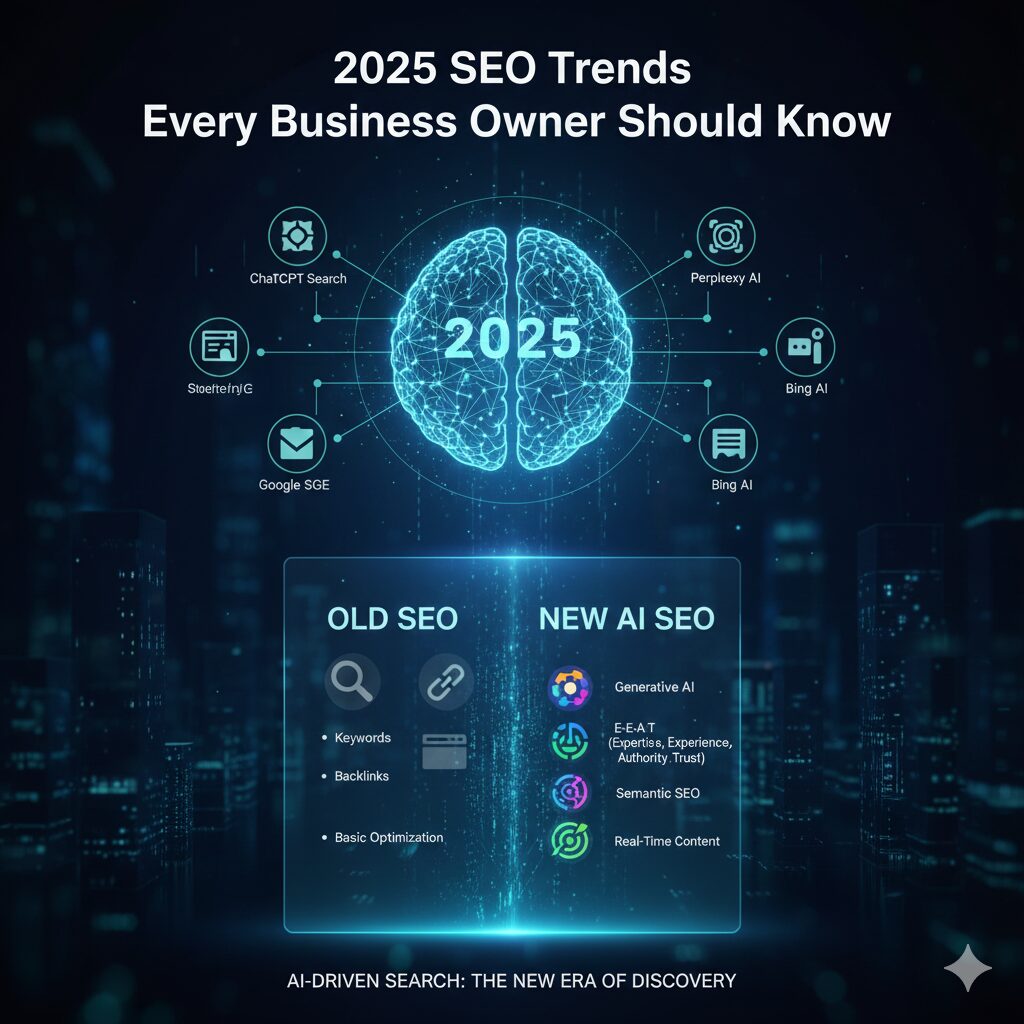
SEO used to be about keywords, backlinks, and website optimization. But in 2025, everything has changed. The rise of AI-driven search platforms like ChatGPT Search, Perplexity AI, and Google’s Search Generative Experience (SGE) has rewritten the rules.
People are no longer searching the same way as before.
They expect:
- instant answers
- clean structured content
- authoritative websites
- AI-friendly formatting
- fast loading
- clear value
In this new era, businesses with outdated SEO strategies will lose visibility, while those who adapt will dominate search results across all platforms.
This blog uncovers the top SEO trends business owners must know in 2025, and how to optimize your website for Google + AI search engines + SGE + ChatGPT + Perplexity all at once.
1. Generative AI Search Is Now the #1 Traffic Source
In 2025, Google is no longer the only place people search. AI tools like:
- ChatGPT Search
- Perplexity AI
- Bing AI
- Google AI Overviews (SGE)
have drastically changed how content gets discovered.
What does this mean for your business?
AI platforms no longer show a list of websites — they summarize answers and recommend the best, most structured, most relevant sites.
Your website must rank on AI as well as Google.
Key requirements for this new era:
- detailed, long-form content
- expert-driven writing
- clean structured data
- FAQ-rich pages
- semantic SEO
- deeper topic clusters
If your content doesn’t provide value, AI will simply ignore it.
2. AI-Focused SEO (AIO) Is Now Essential
Traditional keyword-based SEO is no longer enough. AI SEO (AIO: AI-Optimized SEO) focuses on:
- search intent clarity
- topic depth
- semantic relevance
- E-E-A-T (Experience, Expertise, Authority, Trust)
- structured markup
AI systems gather content from websites and rewrite answers for users. So your content must:
- be authoritative
- be accurate
- be detailed
- be written like a human expert
- match intent perfectly
Your website must be written for both humans and AI models.
3. E-E-A-T: The Strongest Ranking Signal in 2025
Google emphasizes real value from real people, not generic content.
E-E-A-T stands for:
Experience
Have you actually done what you’re writing about?
Expertise
Do you know your field deeply?
Authority
Do others trust and reference your content?
Trust
Is your website secure, transparent, and reliable?
Businesses who demonstrate E-E-A-T outrank competitor sites with weak content.
4. Long-Form, Topic-Deep Content Outsmarts AI & Google
AI search tools prioritize topic authority, not shallow content.
A modern blog must be at least:
- 1,500–2,500 words
- deep, detailed, valuable
- well-structured with headings
- enriched with FAQs
- written with examples
This is how you outrank competitors.
Thin content will be ignored by both Google and AI search.
5. Search Intent Optimization (SIO) Is a Must
In 2025, keywords don’t matter if the intent is wrong.
AI tools analyze:
- user questions
- tone
- reading behavior
- bounce rate
- content structure
Your content must match the exact intent:
Informational intent
(“How to improve website speed”)
Commercial intent
(“Best website developer for small business”)
Transactional intent
(“Hire WordPress developer USA”)
The closer you are to intent = the higher you rank.
6. AI-Generated Content Needs Human Enhancement
AI-generated content alone doesn’t rank anymore.
Google prefers AI-assisted + human-verified content.
The winning combination:
- human structure
- human editing
- human expertise
- AI speed
- AI consistency
This creates the perfect SEO approach.
7. Voice Search Optimization Skyrockets
With ChatGPT Voice, Alexa, Siri, and Google Assistant improving dramatically, voice search queries have increased by 300%.
Voice search SEO requires:
- conversational answers
- FAQ sections
- simple explanations
- natural language
People ask questions like:
“Who is the best website developer near me?”
“Why is my website slow?”
“How do I get more clients from my website?”
Your content must answer these directly.
8. Zero-Click Searches Dominate
Most AI platforms now summarize answers. Users don’t even click.
So your goal is:
be the source AI pulls from.
To do that:
- include bullet points
- create definitive answers
- add FAQs
- use enriched metadata
- write with clarity
- include statistics
AI wants clarity and structure — give it what it wants.
9. Video SEO & Short-Form Content Ranking
YouTube, TikTok, and Instagram reels now appear in AI search results.
Your website needs embedded videos to:
- reduce bounce rates
- increase time on site
- improve SEO
- boost authority
Adding a 45–120 second video increases ranking potential by 30%.
10. Local SEO & AI Maps Optimization Become Crucial
Businesses in USA, Canada, and UK must optimize:
- Google Business Profile
- reviews
- NAP consistency
- service pages
- local keywords
- schema markup
AI search pulls heavily from local sources.
If your business serves a location → you MUST optimize locally.
11. Image SEO and AI Vision Optimization
AI search tools now read:
- alt text
- object detection
- image metadata
- on-page context
Your images must be:
- compressed
- descriptive
- optimized with alt text
- tagged with keywords
This improves ranking across AI platforms.
12. Faster Websites Rank Higher by Default
Speed is a ranking factor.
In 2025:
- slow websites lose traffic
- Core Web Vitals matter more
- hosting quality affects visibility
- mobile speed is priority
A fast website increases:
- visibility
- conversions
- SEO ranking
- user satisfaction
13. Schema Markup Becomes Mandatory
Structured data helps AI models understand your content.
You must add:
- Article schema
- FAQ schema
- Organization schema
- LocalBusiness schema
- Product schema
- Service schema
This makes your website “AI-ready.”
14. User Behavior Data Impacts Rankings
AI evaluates:
- scroll depth
- bounce rate
- reading time
- link clicks
- user satisfaction signals
Business owners must improve:
- user experience
- content clarity
- navigation
- page design
Good UX = better rankings.
15. SEO Is Now Long-Term Brand Building
In 2025, SEO isn’t just ranking pages.
It’s about building:
- authority
- reputation
- trust
- content value
- consistent expertise
The more your brand is searched → the higher your authority → the better your rankings.